Latent space models for opinion mapping and vote prediction
Which latent space models from machine learning or item-response theory can most accurately predict user responses in political questionnaires based on a few initial answers (Bachmann et al., 2024)?
How do the sparsity of the data and the dimensionality of the latent space affect reconstruction and imputation error (Bachmann, 2026)?
How do voters’ and candidates’ answers in political surveys differ, and how does this difference impact the distribution of their positions in the latent space?
2026
PyPI
IXPLORE: Bounded Ideal Point Estimation with Grid-based Uncertainty Quantification
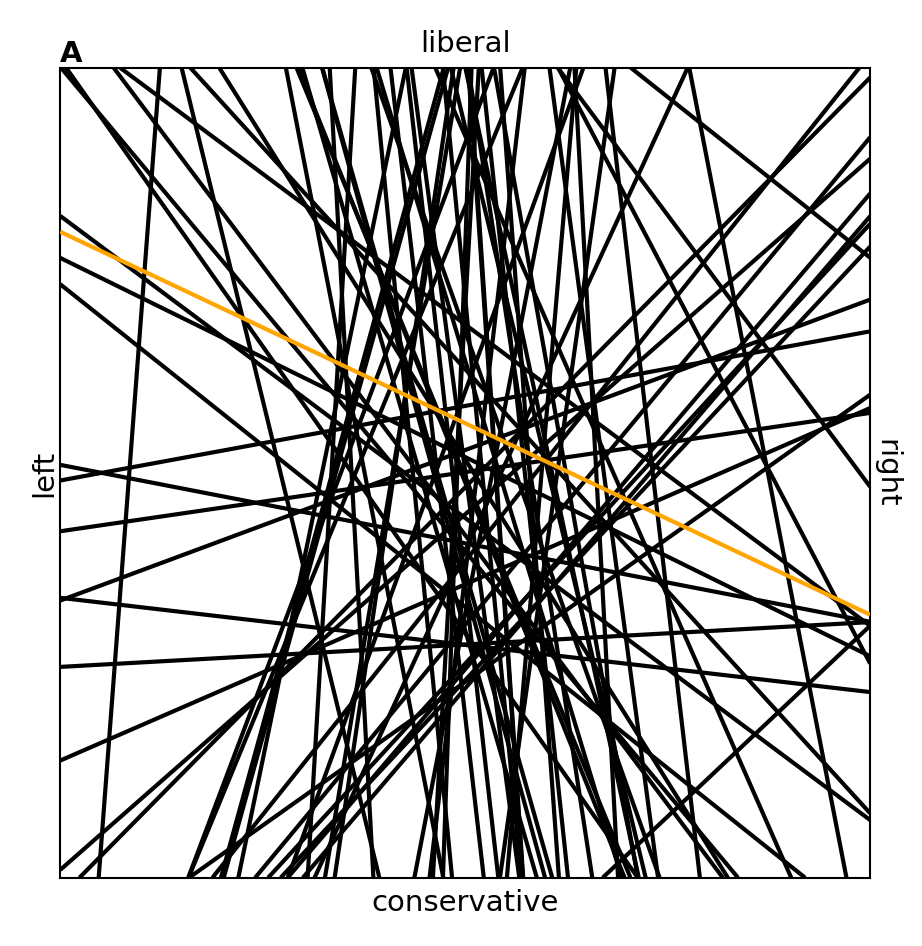
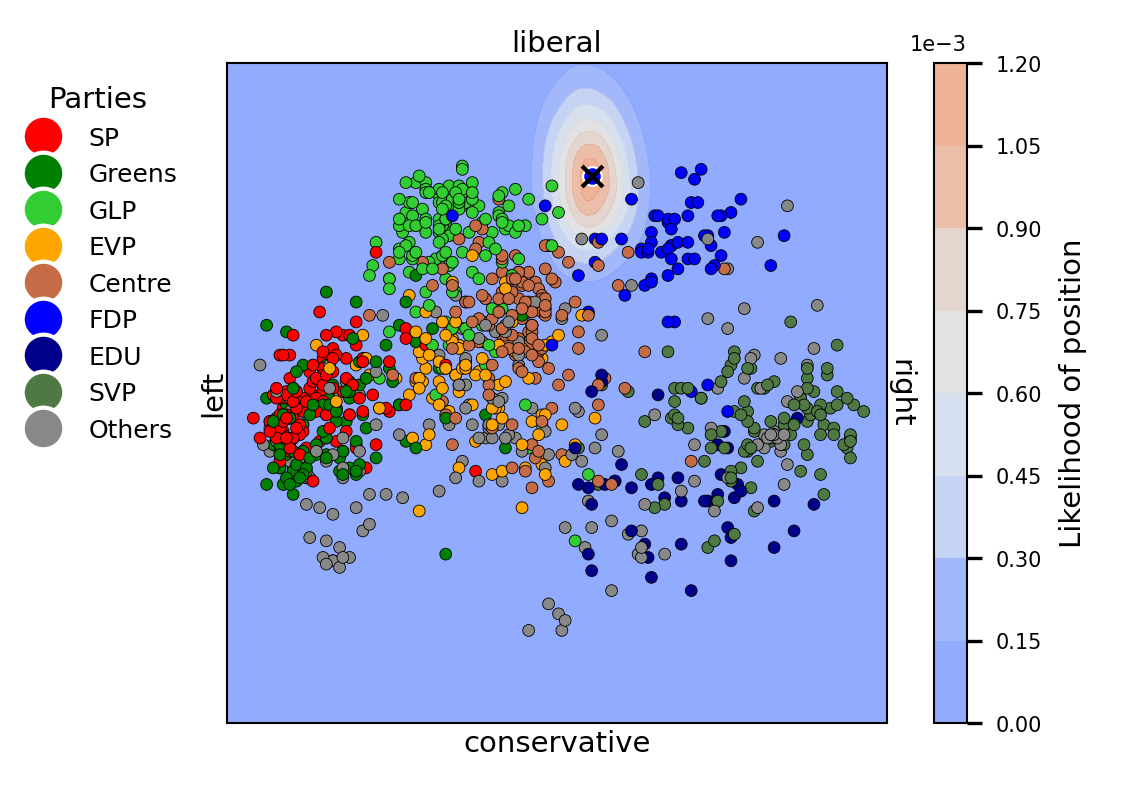
Ideal point estimation is widely used to analyze and visualize political data. However, selecting the corresponding spatial model involves various trade-offs: while Item Response Theory (IRT) approaches are based on utility functions rather than optimized for predictive accuracy, most Machine Learning (ML) alternatives struggle to generalize beyond training data when embedding sparse test responses. We introduce IXPLORE, a bounded ideal point estimation algorithm that combines a predictive fit objective with a sparsity-aware likelihood function. On five benchmark datasets spanning surveys, roll calls, and deliberation, this approach surpasses IRT- and ML-based algorithms on reconstruction and imputation error – especially for users with sparse responses. Furthermore, we show that non-linear feature transforms can further reduce the reconstruction error while remaining visually interpretable. To quantify uncertainty, IXPLORE applies grid-based posterior inference on a bounded 2D latent space. Available as a Python package on PyPI, IXPLORE offers a flexible framework for constructing bounded, interpretable political maps with fast inference and strong imputation performance.
2024
ECML/PKDD
Fast and Adaptive Questionnaires for Voting Advice Applications
The effectiveness of Voting Advice Applications is often compromised by the length of their questionnaires. To address user fatigue and incomplete responses, some applications (such as the Swiss Smartvote) offer a condensed version of their questionnaire. However, these condensed versions cannot ensure the accuracy of recommended parties or candidates, which we show to remain below 40%. To address these limitations, this work introduces an adaptive questionnaire approach that selects subsequent questions based on users’ previous answers, aiming to enhance recommendation accuracy while reducing the number of questions posed to the voters. Our method uses an encoder and decoder module to predict missing values at any completion stage, leveraging a two-dimensional latent space that is reflective of the traditional methods used in political science for visualizing ideology. Additionally, a selector module is proposed to determine the most informative subsequent question based on the voter’s current position in the latent space and the remaining unanswered questions. We validated our approach using the Smartvote dataset from the Swiss Federal elections in 2019, testing various spatial models and selection methods to optimize the system’s predictive accuracy. Our findings indicate that employing the IDEAL model both as encoder and decoder, combined with a PosteriorRMSE method for question selection, significantly improves the accuracy of recommendations, achieving 74% accuracy after asking the same number of questions as in the condensed version.